

The Thermodynamics of High-Altitude Combustion
For the veteran off-grid operator, relying on traditional propane combustion in the high-altitude Bureau of Land Management (BLM) territories of Colorado or Wyoming introduces severe thermodynamic limitations. Propane is stored as a liquid under pressure, and its vaporization is a highly endothermic process. As ambient temperatures drop, the vapor pressure of propane decreases exponentially. At -44°F, it ceases to vaporize entirely. However, even at 20°F at 10,000 feet of elevation, the combination of low atmospheric pressure and extreme cold severely restricts the BTU (British Thermal Unit) output of a standard regulated stove. The physical limitation is dictated by the vaporization rate, which is a function of the wetted surface area of the cylinder and the ambient temperature gradient. High-output combustion stoves under these conditions require specialized high-pressure regulators (operating at 15-20 PSI rather than the standard 11 water column inches) and often necessitate active heating blankets for the DOT cylinders to maintain a stable phase change. Without managing the enthalpy of vaporization, your 10,000 BTU burner will effectively operate at 4,000 BTUs, tripling your boil times and wasting critical fuel reserves during long-term boondocking.
Migrating to 48V Induction: The Mathematical Imperative
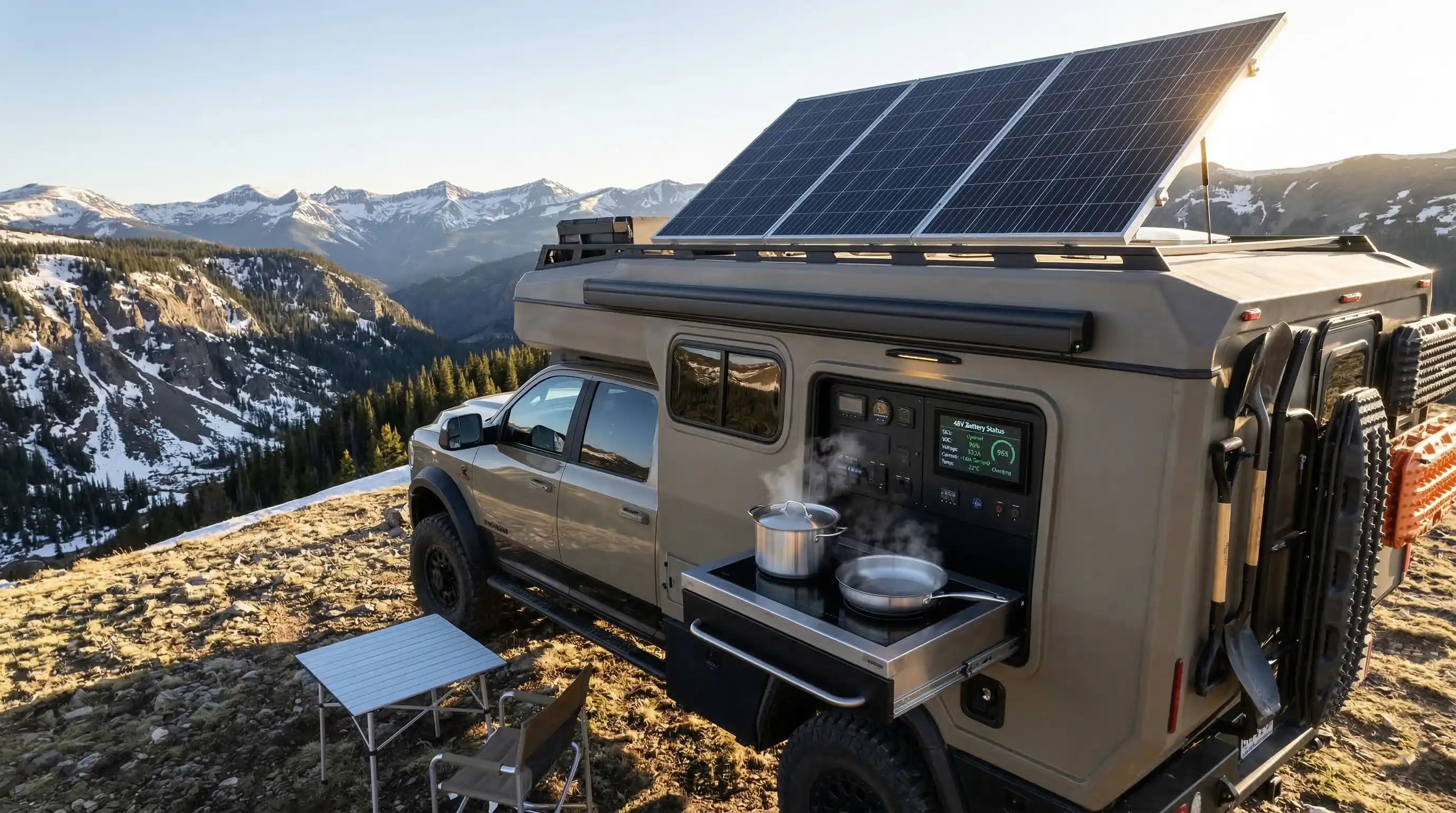
In 2026, the gold standard for off-grid culinary logistics is the complete eradication of fossil fuels in favor of high-efficiency induction systems paired with a 48V LiFePO4 architecture. Induction cooking utilizes high-frequency electromagnetism to excite the ferrous molecules in cookware, yielding an energy transfer efficiency of approximately 85%, compared to a dismal 40% for open-flame propane. To calculate the exact load of a 1800W induction cooktop on a 48V battery bank, we must factor in inverter overhead. Using the formula $I = \frac{P}{V \times \eta_{inv}}$, where $P$ is 1800W, $V$ is the nominal 51.2V of a 48V lithium bank, and $\eta_{inv}$ is a typical inverter efficiency of 0.90, the continuous current draw is approximately 39 Amps. If the same load were placed on a legacy 12V system, the draw would exceed 165 Amps, triggering massive Peukert-effect losses and requiring unwieldy 4/0 AWG cabling. By transitioning to a 48V micro-grid, you mitigate severe $I^2R$ thermal losses in your wiring harness and maintain a flat discharge curve, allowing for multi-course meal preparation without triggering a low-voltage disconnect on your primary inverter.
Energy Budgets and Solar Replenishment
When engineering an all-electric cooking setup for a 14-day BLM stay, your solar array geometry and battery capacity must be meticulously balanced. Boiling one liter of water (from 50°F to 212°F) requires roughly 0.1 kWh of thermal energy. Accounting for system inefficiencies, an induction cooktop will pull approximately 120 Watt-hours (Wh) from your battery bank for this task. A veteran preparing three hot meals a day can expect a daily culinary load of 1.5 to 2.5 kWh. To sustain this in the volatile irradiance environments of the Pacific Northwest or heavily canopied BLM forests, your rig must feature an oversized, high-voltage solar array. We recommend utilizing residential-grade panels (350W+ each) wired in series to push high voltages (100V-150V) into your MPPT charge controller. This high-voltage string setup ensures that even during early morning or heavy overcast conditions, the array voltage remains high enough above the battery voltage to initiate bulk charging, replenishing your induction-depleted batteries before noon.
Starlink Telemetry and Load Shedding
Integrating your cooking appliances into a smart off-grid telemetry system is crucial for preventing catastrophic battery depletion. Advanced setups utilize systems like the Victron Cerbo GX, which monitors shunts and inverter loads in real-time. By connecting this ecosystem to a low-latency Starlink connection, veterans can implement automated load-shedding protocols. For example, if your induction cooktop is drawing 2000W and a cloud bank drops your solar harvest to zero, a pre-programmed relay can automatically disconnect secondary non-critical loads (like an electric water heater element or air conditioning unit) to prioritize the culinary task and protect the battery's state of charge (SoC). This level of automation prevents the need for manual micromanagement of the electrical bus during peak usage.
Legal Compliance: 43 CFR 9212 and Fire Restrictions
The transition to induction is not merely a technical upgrade; it is a legal safeguard. Across the arid regions of the West, BLM field offices frequently implement Stage 1 and Stage 2 fire restrictions under 43 CFR Part 9212. During Stage 2 restrictions, open flames, including campfires and charcoal grills, are strictly prohibited. While pressurized liquid or gas stoves with mechanical shut-off valves are generally exempt, the specific language of local orders can sometimes lead to ranger misinterpretation. An induction cooktop completely bypasses this legal gray area. There is no open flame, no localized spark hazard, and zero risk of igniting surrounding dry cheatgrass. Maintaining a fully electric cooking system ensures your 14-day occupancy remains uninterrupted by aggressive fire ban enforcement, while simultaneously adhering to the strictest interpretations of Leave No Trace (LNT) principles.