

The Thermodynamics of Sublimation and Lyophilization
For the veteran off-grid expeditioner pushing the boundaries of 14-day BLM limits, standard grocery procurement is fundamentally flawed due to high water weight and rapid spoilage. The superior logistical solution is Lyophilization, commonly known as freeze-drying. Unlike standard thermal dehydration—which uses convective heat to evaporate moisture and often destroys complex macronutrients—lyophilization relies on the physics of sublimation. The food is flash-frozen to below -40°F, and the surrounding environment is subjected to a profound vacuum. Under these specific barometric conditions, solid ice crystals transition directly into water vapor, bypassing the liquid phase entirely. This process preserves the cellular structure and up to 97% of the original nutritional profile. For high-exertion activities like backcountry scouting or technical rig recovery, maintaining access to non-denatured proteins and complex carbohydrates without relying on a continuously running 12V compressor fridge is a massive tactical advantage.
Osmotic Pressure and Rehydration Mathematics
The efficiency of freeze-dried provisions is entirely dependent on your rig's water logistics. When rehydrating food in an arid BLM environment like the Mojave, every fluid ounce of water is critical. The physical process of rehydrating lyophilized cells is governed by osmotic pressure, represented by the equation $\\Pi = iMRT$, where $M$ is the molarity of the solution and $T$ is the absolute temperature. To minimize water waste and fuel consumption (or inverter battery drain), veterans utilize thermal retention cooking. Rather than maintaining a rolling boil for 15 minutes, the water is brought to a rapid boil once, added to the vacuum-sealed Mylar pouch, and the pouch is immediately placed inside an insulated, reflective cozy. This traps the thermal energy, maintaining a high $T$ variable for extended periods, driving the osmotic gradient and fully reconstituting the cellular matrix of the food without requiring continuous energy input. This method saves up to 40% of the daily culinary energy budget.
Thermal Mass Management in 12V Compressor Fridges
While dehydrated foods form the backbone of a deep-boondocking pantry, fresh provisions are inevitably stored in 12V DC compressor refrigerators (such as ARB, Dometic, or Iceco units). For off-grid veterans, managing the 'thermal mass' inside these units is critical to battery conservation. A half-empty fridge forces the compressor to cycle constantly, rapidly draining your LiFePO4 bank overnight. Dehydrated and vacuum-sealed food blocks can be utilized as secondary thermal masses. By packing dense, vacuum-sealed bags of dehydrated provisions into the empty voids of your 12V fridge, you reduce the volume of atmospheric air that spills out when the lid is opened. These dense food blocks absorb and retain the cold, extending the compressor's duty cycle from a high-draw rapid pulse to a highly efficient, slow, and sustained cooling rhythm, saving precious amp-hours for your Starlink and communications arrays.
Caloric Density and Space Engineering
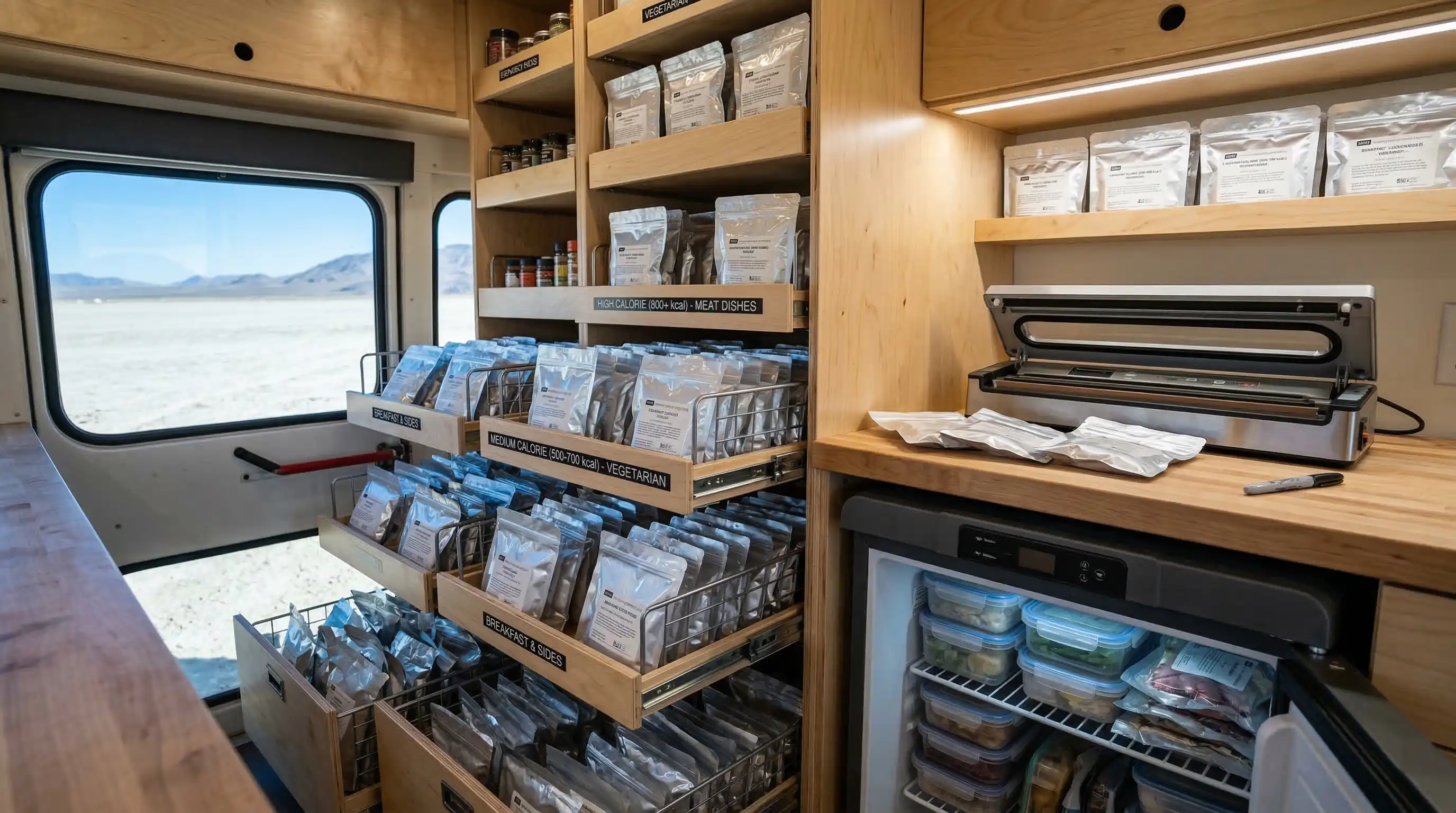
RV payload capacities and storage volumes are finite resources governed by gross vehicle weight ratings (GVWR). The seasoned boondocker views food solely through the lens of caloric density (calories per gram). Standard canned goods are a logistical nightmare, containing roughly 80% water and yielding incredibly poor caloric density while adding massive unsprung weight to your suspension. A custom freeze-dried payload, vacuum-sealed in oxygen-impermeable Mylar bags with 500cc oxygen absorbers, can pack 5,000 calories into a space no larger than a shoebox, weighing less than two pounds. This extreme reduction in weight-to-calorie ratio frees up hundreds of pounds of payload capacity, allowing the veteran to haul more critical technical gear, such as extra solar panels, recovery equipment, or high-capacity lithium battery expansions.
Waste Minimization and LNT 2.0 Directives
Deep BLM boondocking demands strict adherence to 'Leave No Trace' (LNT) principles, but experts push this to 'LNT 2.0'. Traditional food packaging generates immense volumes of uncrushable plastic and metal waste, which quickly fills limited garbage receptacles and invites unwanted wildlife interaction. Freeze-dried and dehydrated foods, prepared and vacuum-sealed by the veteran prior to departure, consolidate packaging into flat, highly compressible Mylar pouches. Once the meal is consumed, the pouch can be washed with a minimal graywater spray, dried, and packed completely flat. A 14-day food supply for two adults generates less waste than a single trip to a fast-food drive-through. Furthermore, because rehydration water is fully absorbed into the food, this method produces zero liquid culinary waste, completely eliminating the need to dispose of food-tainted graywater onto the fragile cryptobiotic soils of the desert floor, ensuring absolute legal compliance with BLM resource protection mandates.