

The Physics of LED Photonics and Efficacy
Operating outside your rig on remote BLM land—whether executing a midnight suspension repair or scouting a rocky turnaround—requires precision illumination. The era of cheap, harsh blue LEDs is over. For the expert, the critical metrics are Luminous Efficacy (lumens per watt) and the Color Rendering Index (CRI). High-end emitters, such as the Nichia 519A or the CREE XHP70.3, utilize a complex phosphor layer over a blue diode to produce light. Standard flashlights emit a washed-out, cool white light (6500K) with a low CRI of around 70, which washes out topological contrasts and makes identifying a brown rattlesnake against red sandstone nearly impossible. The veteran demands a High-CRI emitter (90+), which mimics the full spectrum of a black-body radiator (the sun). This photonic accuracy allows the human eye to perceive depth and true color, drastically reducing ocular fatigue during extended night operations and improving safety during technical backcountry recoveries.
Battery Chemistry: The 21700 Lithium-Ion Standard
The power source for your illumination gear must align with the extreme environmental demands of off-grid boondocking. Legacy AA alkaline batteries suffer massive internal resistance in sub-freezing temperatures, rendering them useless in the high-altitude Rockies. The 2026 standard is the 21700 rechargeable lithium-ion cell. These cells (measuring 21mm by 70mm) offer a massive leap in energy density over the older 18650 format. A high-quality 21700 cell (like the Samsung 50S) can safely store 5,000 mAh of energy and deliver a sustained 25-Amp discharge. This high discharge capability is required to drive modern 'Turbo' modes on premium flashlights, which can pull over 100 Watts to generate 4,000+ lumens for brief, intense sweeps of the desert floor. Furthermore, these cells can be directly recharged via USB-C PD (Power Delivery) from the rig's central 48V/12V LiFePO4 house bank, ensuring your handheld lighting is infinitely sustainable via your rooftop solar array.
Thermal Management and Step-Down Algorithms
Generating massive lumen outputs in a compact aluminum flashlight housing creates a severe thermodynamic bottleneck. An LED pulling 15 amps generates extreme heat at the diode junction. If this heat is not dissipated, the emitter will permanently degrade or the lithium-ion cell will enter thermal runaway. Expert-grade flashlights utilize direct-thermal-path copper MCPCBs (Metal Core Printed Circuit Boards) and advanced PID (Proportional-Integral-Derivative) thermal regulation algorithms. Instead of relying on a simple timed step-down (which abruptly drops your light output after 60 seconds regardless of outside temperature), a PID sensor actively monitors the head temperature. If you are using the light in a freezing Montana blizzard, the PID algorithm will allow the flashlight to maintain a higher lumen output indefinitely, utilizing the freezing ambient air as a massive heat sink to shed the thermal load from the aviation-grade aluminum fins.
The Inverse-Square Law and Candela Ratings
While marketing departments push total 'Lumens', the veteran understands that 'Candela' (peak beam intensity) is the true metric of a flashlight's reach. The physics of illumination are governed by the inverse-square law, $E = rac{I}{d^2}$, meaning the illuminance ($E$) decreases proportionally to the square of the distance ($d$) from the source. To punch through the dust suspended in the Mojave air and illuminate a canyon wall 500 meters away, you do not need more lumens; you need a deeply mirrored parabolic reflector or a TIR (Total Internal Reflection) optic to focus the photons into a tight beam, massively increasing the Candela rating. A specialized 'thrower' flashlight might only have 1,500 lumens but boast 250,000 candela, allowing for precise, long-range scouting without causing 'backscatter' blindness from illuminating the dust particles immediately in front of your face.
Dark Sky Preservation and BLM Nuisance Laws
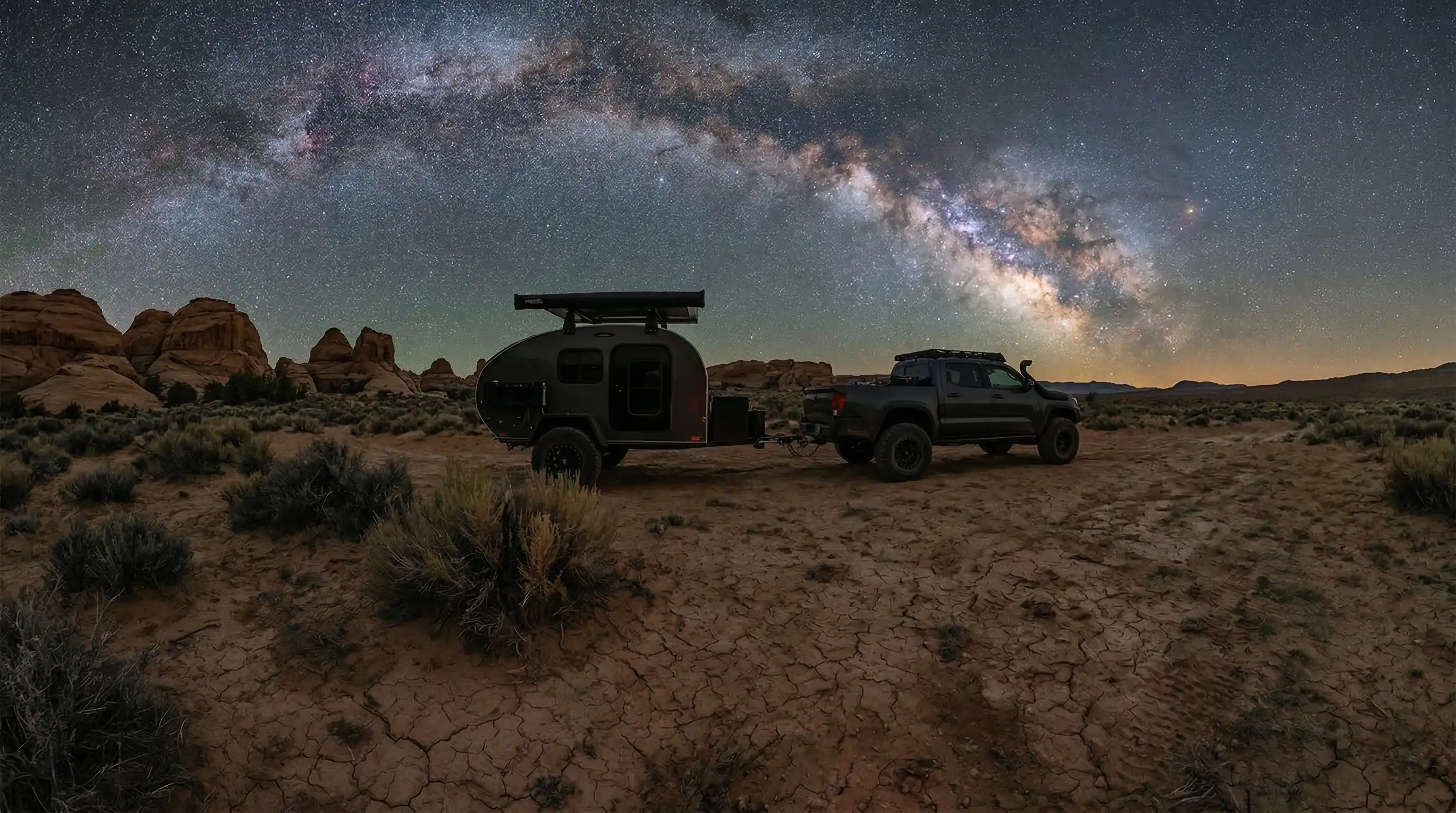
Under BLM regulations surrounding 'creating a nuisance' (often applied via 43 CFR 8365.1-4), massive light pollution is increasingly becoming a target for ranger citations. Deep boondocking locations are prized for their 'Dark Sky' qualities. Running a 20,000-lumen LED light bar or flooding the desert with harsh, 6500K area lanterns destroys the scotopic (night) vision of surrounding campers and severely disrupts nocturnal wildlife rhythms. The expert adheres to strict light discipline. Lanterns must feature 'warm' emitters (2700K to 3000K) to minimize atmospheric scattering. Furthermore, tactical headlamps must feature a dedicated Red-Light mode (emitting in the 620-750 nanometer wavelength). Red light does not bleach rhodopsin, the photopigment responsible for human night vision, allowing the veteran to navigate their campsite, operate Starlink router panels, or adjust solar charge controllers without broadcasting their position or ruining their natural visual acuity in the dark.